
RAV4 PHEV orders say nothing about plugging in on a road trip
An order book counts who paid for the plug, not who uses it. Here's what the surveys show about PHEV charging, and how to plan a summer trip.

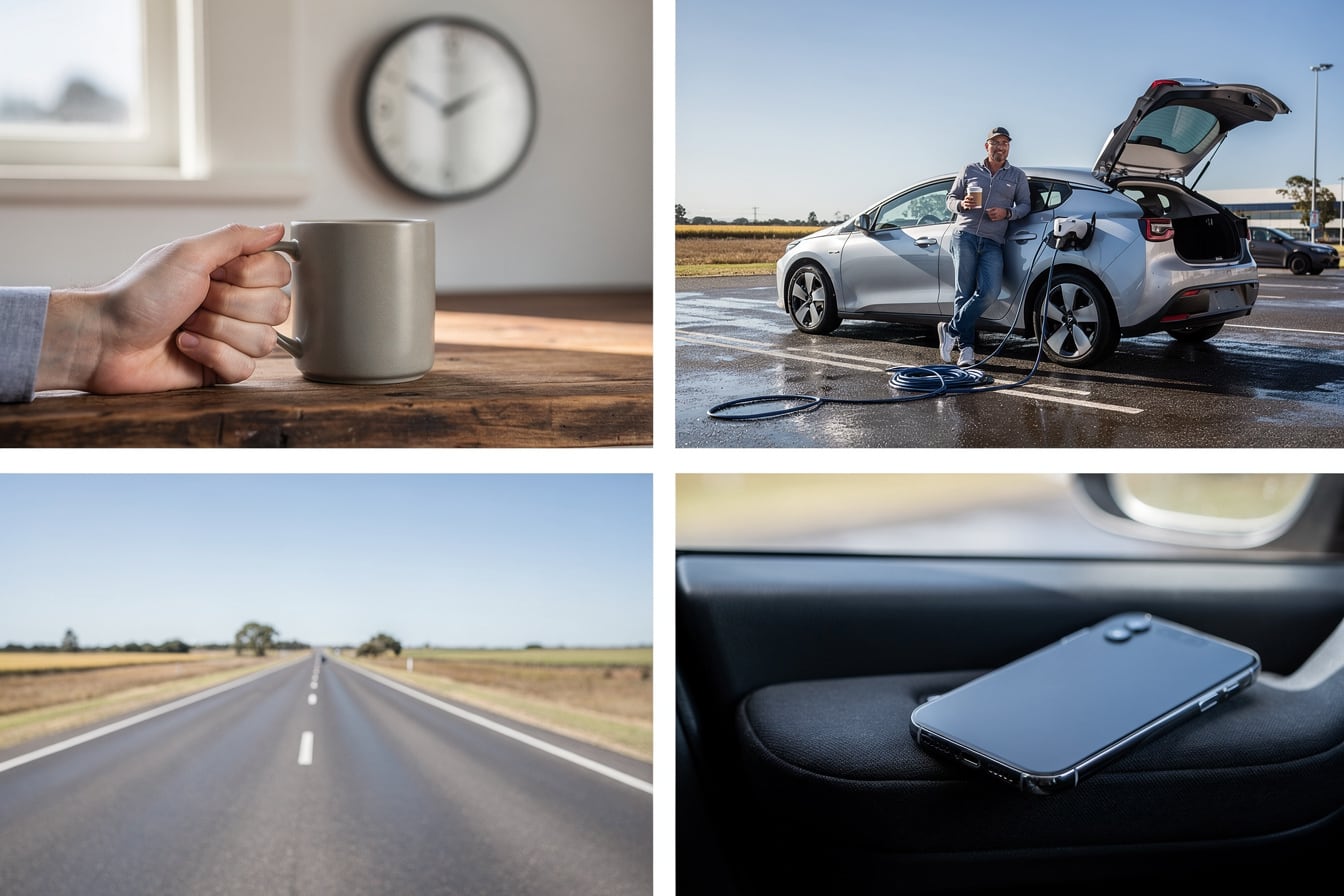
It's a Saturday morning in January. The car pulls out of a Brisbane driveway with a full battery, a full tank and a week of holiday ahead. This family is made up for illustration, but plenty of new plug-in hybrid owners will know the trip.
At home the routine is easy. The car goes on the charger overnight, and the school run, the shops and footy training all happen on electricity. Most days the petrol engine barely starts.
Then they hit the motorway south. The battery is flat before the border, and from there the trip comes down to one question. Did anyone plan a stop to charge it again, or does the petrol engine do the rest of the week?
A plug-in hybrid only drives on electricity when someone has charged it. If it never sees a power point, it's a petrol car carrying a battery around. That's why the current talk about RAV4 PHEV orders tells you less than you'd think.
What the RAV4 order book actually measures
Toyota is talking about RAV4 PHEV orders right now. Carsales reports Toyota Australia's VP of Sales, Marketing and Franchise Operations, John Pappas, saying order intake is tracking in line with the company's plan. GoAuto reports he called the plug-in share of RAV4 sales a planning assumption rather than a confirmed figure.
Either way, an order book counts people who paid for the plug. It can't tell you whether that battery gets charged halfway down the coast in January, or rides along empty from Coolangatta to Coffs.
That's not a dig at Toyota. Sales data was never built to answer that question. How often a car gets plugged in is a separate measurement, and it comes from owner surveys and service records.
What the everyday charging surveys show
The everyday numbers look decent, with a few catches.
ABC News reports an Electric Vehicle Council survey of 625 private PHEV owners in Australia. Most charged nightly, and they drove in EV mode for around 65 percent of trips. Zecar covered the same research and points out the sample probably leans towards keener, more engaged owners. That's fair. People who fill in a charging survey are more likely to be people who charge. Also, a share of trips isn't a share of kilometres. Short trips are the easiest ones to do on battery.
The ABC also reported BYD's own service-record data, which splits its plug-in hybrids' kilometres roughly half on electricity and half on petrol. Service records don't depend on who bothers to answer a survey, so they're a useful check.
Europe has more data, and it's less flattering. Fraunhofer ISI found private plug-in hybrid owners drove on electricity for less than half their distance, well below the share official tests assume. Company car drivers used electric mode even less. The ICCT's real-world study links those low electric shares to how rarely the cars get charged, especially company cars.
The biggest dataset comes from the fuel-consumption monitors fitted to new cars in the EU. A peer-reviewed analysis in MDPI Energies looked at roughly 457,000 plug-in hybrids from 2021 to 2023 and found a large gap between real-world and official CO2 figures. The Driven, reporting on that research, says the gap comes down to infrequent charging.
Every study points the same way. When owners plug in often, a PHEV does a lot of its driving on electricity. When they don't, it drives like a petrol car.
The long-trip gap nobody has measured
New Zealand gives a hint about where long trips go. EECA, the country's energy efficiency agency, surveyed 712 EV drivers. Public charger use rose from 49 percent in 2021 to 76 percent in 2023, mostly for longer journeys. And 55 percent said queuing puts them off using public chargers more often. That survey covers EV drivers in general, not plug-in hybrids, so it shows the pattern without settling the PHEV question.
Here's the gap. Nobody has published how often plug-in hybrids get plugged in on long or regional trips. Toyota hasn't, the Electric Vehicle Council hasn't, and neither have the European researchers. The everyday surveys measure the garage routine. A road trip takes the garage away.
At home the charger is a metre from where you park. On holiday it's somewhere you have to decide to stop. That decision is the bit no survey has measured, and the bit you control.
How to plan a plug-in hybrid road trip before you leave
Don't assume a charger will turn up when you need one. Sort it out before you leave, with the family still at home and the car still in the driveway. Here's the sequence I'd follow.
- Decide what kind of trip it is. Either you plan charging stops, or you accept that most of the drive runs on petrol. Both are fine. Deciding nothing is how you end up with the second one by accident at a servo.
- Check what your car accepts. Look up its connector type and the charging power it can take, and don't assume. A plug-in hybrid's charging setup can be quite different from a full EV's.
- Put charging where you'd stop anyway. Lunch, coffee, a toilet break, the motel. A charge you don't have to make a detour for is a charge you'll actually do.
- Have a backup near every stop. No app in Australia or New Zealand can promise a charger will be free and working when you pull in. In the EECA survey, queuing was the biggest thing putting people off public chargers.
- Know where the fuel is. On a regional leg with thin charging, the petrol engine is your plan B, so treat it as one.
- Plan while you still have signal. Maps and route planning need data, and some of the best holiday roads have very little coverage.
That's the whole method. It takes about as long as packing the boot, and it decides whether the battery you paid for gets used on the trip.
Charge Nomad does that planning for you on iPhone and Android. The Route Planner takes your car and battery percentage, works out where to stop, how long to charge and how much battery you'll arrive with, puts a backup charger near every stop, and flags legs where the chargers genuinely aren't there yet before you commit. Fuel station mode adds petrol stations from OpenStreetMap for mixed plug-in hybrid trips, and Charge & Explore finds chargers within an easy walk of coffee, food, shops or toilets.
The Route Planner is part of Charge Nomad+, which has a 7 day free trial on the monthly plan. On iPhone it's $4.99 a month or $39.99 a year in Australia. On Android the price is shown in Google Play, and prices vary by country. The charger map is free, filters by connector type and power output, and matches chargers to your exact car. Stranded mode is free too. The app doesn't show whether a charger is free or working right now, and no app here should claim it does. The map and the Route Planner need data, but the calculators still work with no signal.
See what the app actually does before you download it: evbygenz.com/app
Questions drivers ask
How often do plug-in hybrid owners actually charge?
ABC News reports an Electric Vehicle Council survey of 625 private PHEV owners in which most charged nightly and drove in EV mode for around 65 percent of trips. Zecar notes the sample probably leans towards keener owners. BYD's service records split its plug-in hybrids' kilometres roughly half electric and half petrol.
Can I take a plug-in hybrid on a road trip without charging it?
Yes. Once the battery is empty, the petrol engine drives the car, so the trip still works. You just won't be driving on electricity, and you'll be carrying the battery around without using it.
Does Charge Nomad show whether a charger is available?
No. Charge Nomad doesn't show availability from charging operators, and no app in Australia or New Zealand should promise it. That's why the Route Planner puts a backup charger near every planned stop.
Is the Charge Nomad Route Planner free?
The Route Planner is part of Charge Nomad+, with a 7 day free trial on the monthly plan on iPhone and Android. On iPhone it's $4.99 a month or $39.99 a year in Australia, and on Android the price is shown in Google Play. The charger map, Stranded mode and most of the other tools are free.
// SOURCES
- carsales.com.au: Toyota RAV4 plug-in hybrid now nearly a third of orders
- GoAuto: Toyota RAV4 sales to be 30 per cent PHEV
- ABC News: How often do plug-in hybrid users recharge?
- Zecar: PHEV owners' plug-in charging behaviour research in Australia
- Fraunhofer ISI: Real-world fuel consumption of plug-in hybrid vehicles
- ICCT: Real-world usage of plug-in hybrid vehicles in Europe
- MDPI Energies: Analysis of EU OBFCM data for plug-in hybrid vehicles
- The Driven: Real-world fuel consumption of plug-in hybrids is 300 per cent higher than official ratings
- EECA: Kiwis report on changing EV charging needs
- Charge Nomad