
Charger queues are real. The numbers behind them don't agree
A new HERE and SBD study says Australia's public charging is under strain. Here's why the ratios disagree and how to plan regional stops.

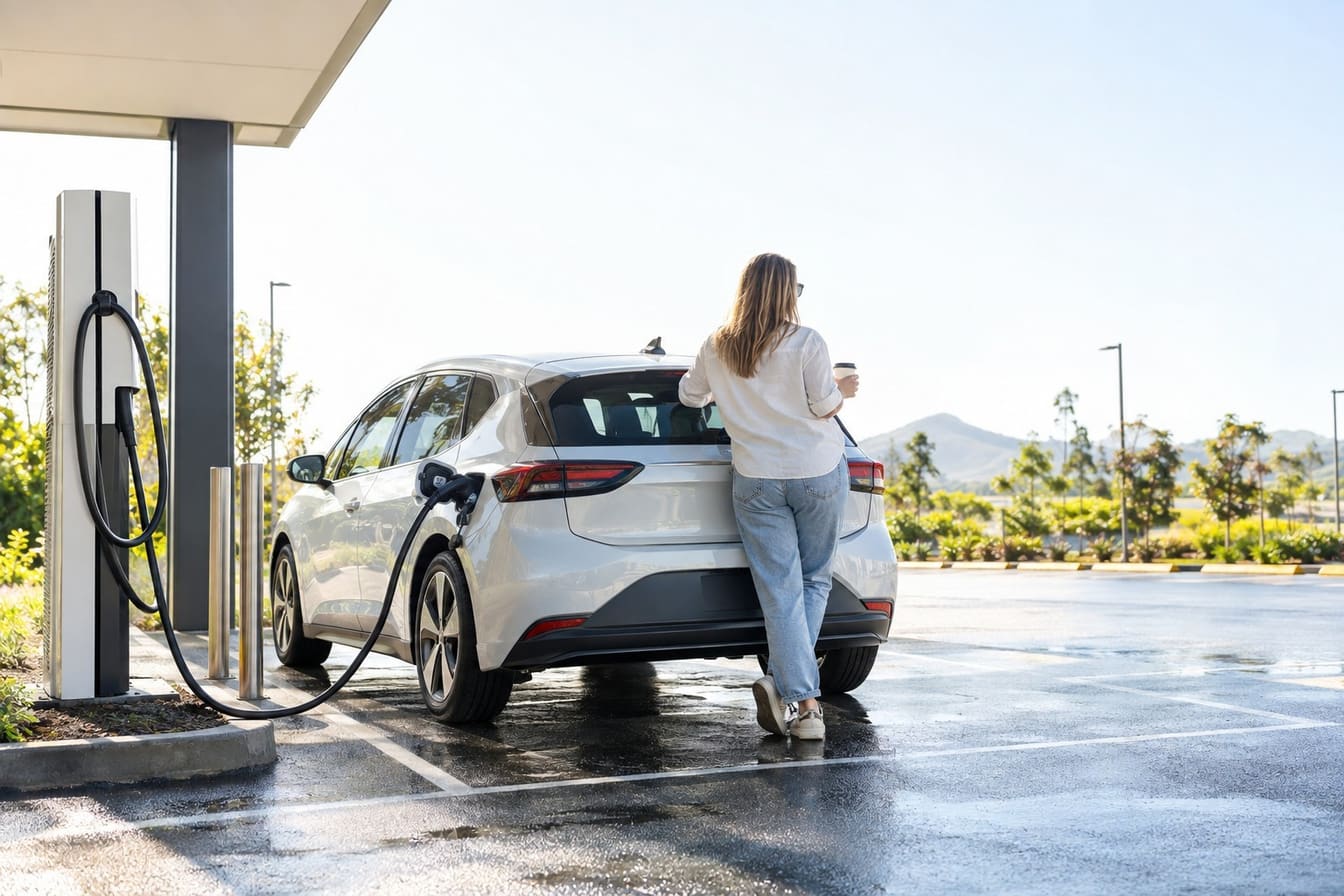
It's just after midday at a regional fast charger, somewhere between two towns you've only ever driven through. The one plug that suits your car already has a car on it. The driver is in the cafe across the road, and you have no idea when they'll be back.
So you start doing the maths. How much battery you've got left. Whether you can make the next town. Whether lunch is about to run an hour longer than you planned.
That's a composite, not one driver's story. If you've done a few regional runs in an EV, though, you've lived some version of it. In September a study put a label on the feeling.
What the EV Index 2026 says about Australia
HERE Technologies and SBD Automotive publish an EV Index, and HERE's own page for the 2026 edition confirms Australia is in it. The finding that made the news here was blunt: Australia's public charging network is under strain as electric car sales rise.
The Driven reported it on 10 September, with comments from HERE and SBD spokespeople. Its story also makes a point that matters for anyone planning a long drive: readiness varies from state to state. AAP News ran the story too, with comments from Deon Newman, HERE Technologies' Asia Pacific general manager, and Robert Fisher, SBD Automotive's senior consulting manager.
We're not repeating the headline ratios here. They're the part of this story we trust least, and the next section explains why.
Why the EV charger numbers don't agree
Then there's carsales. It ran its own EV-to-charger ratio for Australia, a different number again, and cited the IEA's Global EV Outlook 2025 as the source. We went to the charging page of that IEA report to check. Australia isn't in the chart.
That doesn't prove the carsales figure is wrong. It means we couldn't trace it, and a number you can't trace shouldn't decide where you stop for lunch.
The bigger problem is definitions. We couldn't find how each study defines a public charger. Is it a site or a plug? Does a slow AC post in a shopping centre car park count the same as a DC unit on a highway? On our own charger map, Standard means up to 50kW, Rapid is 50 to 149kW and Ultra-rapid is 150kW and above. On a road trip those are three very different stops. Lump them together and you get one ratio. Count only the fast ones and you get another. Count plugs instead of sites and it moves again.
None of the reporting we read covers New Zealand either. And not one of these figures can tell you whether the charger you're driving towards has a car on it.
So here's our take. Read any single ratio as a pressure gauge, not a headcount. The studies disagree on the number, but they all point the same way, and the direction is the useful part. On a regional trip the question isn't how many chargers Australia has. It's what you do when the one you planned on is taken, slow or out of action.
How to plan regional stops when chargers are busy
In practice, it comes down to a handful of habits. None of them is complicated. They just have to happen before you leave, not in the car park.
- Arrive with margin, not on fumes. Plan to roll in with 15 to 20 percent left. That buffer is what lets you drive on to the next site if the first one is taken.
- Charge to a sensible level and move on. Around 80 percent per stop is a fair target. Sitting there for the last few percent while someone waits behind you is how a queue gets longer.
- Know your second stop before you need it. Pick a backup near every planned charger while you're at home with signal and time, not on the side of the highway.
- Favour sites with more bays. At a single-plug site, one car ahead of you is the whole wait. At a site with several bays, a queue has somewhere to go.
- Read what the last driver said. A note about a cable playing up or a unit that's been slow tells you more about your next stop than any national ratio.
- Check the plug suits your car. Don't assume every car is Type 2 and CCS2, particularly if you drive a Nissan Leaf or an imported EV.
Do all six and a taken charger becomes a ten minute detour instead of a stuffed afternoon. That's an illustration, not a promise, because the next site can be busy too. The point is that you've already made the decision before you're tired and low on battery.
Where Charge Nomad fits
You can do every one of those by hand with a map, a notepad and some patience, or let Charge Nomad do it. Charge Nomad is our app, made by EV by Gen Z, and it's on iPhone and Android. The charger map is free. It filters by number of bays, connector type, power output and network, including networks you'd rather avoid, and it matches connectors to your exact car instead of assuming Type 2 and CCS2. Every station shows star ratings and short notes from other drivers, and you can leave your own or report anything that's wrong.
The Route Planner is part of the optional Charge Nomad+ upgrade. You give it a start, a destination, your car and your battery percentage. It plans around an arrival buffer that defaults to 15 to 20 percent and an 80 percent target per stop, gives every planned stop a backup charger nearby, and flags legs where the charging genuinely isn't there yet before you commit to the route. On iPhone it can also pick stops by Reliable, Cheapest or Fastest.
Two free tools earn their place when a charger is busy. Charge & Explore finds chargers within an easy walk of coffee, food, shops or toilets, with a walking route, so a wait isn't dead time. Stranded mode is a separate low-battery screen that finds the closest charger you can actually reach and shows the right emergency and roadside numbers for Australia or New Zealand.
Now the limits. The app can't show you which bays are in use as you roll in, and no app should promise that here. The map, the Route Planner and Charge & Explore need data, so plan before you lose signal. The calculators run on the phone and keep working without it.
On iPhone, Charge Nomad+ is $4.99 a month or $39.99 a year in Australia, with a 7 day free trial on the monthly plan. On Android the monthly plan also has a 7 day free trial, and the price is shown in Google Play. Prices vary by country. Most of the app works without an account, and there are no ads anywhere in it.
See what the app actually does before you download it: evbygenz.com/app
Last time you waited at a regional charger, did you already have a second stop worked out, or did you find one on the spot?
Questions drivers ask
Is Australia's public EV charging network under strain?
The HERE Technologies and SBD Automotive EV Index 2026 says it is, and The Driven and AAP News both reported that finding. Other outlets have published their own ratios, and they don't agree because each one counts chargers differently. Read any single figure as a sign of pressure, not an exact count.
Why do EV-to-charger ratios for Australia differ so much?
Studies don't always say whether they count sites or plugs, or whether slow AC posts sit in the same bucket as DC fast chargers. Change the definition and the ratio changes. When we checked the IEA's Global EV Outlook 2025 charging page, which carsales cited for its figure, Australia wasn't in the chart.
Can Charge Nomad show whether a charger is in use?
No. Charge Nomad doesn't show which bays are in use, and no app should promise that here. It shows ratings and notes from other drivers, filters sites by number of bays, and the Route Planner gives every planned stop a backup charger nearby.
Is the Charge Nomad Route Planner free?
The Route Planner is part of the optional Charge Nomad+ upgrade, along with the Range Estimator and more than one car in your garage. The charger map, Stranded mode and the other tools are free on iPhone and Android. On iPhone, Charge Nomad+ is $4.99 a month or $39.99 a year in Australia with a 7 day free trial on the monthly plan, and prices vary by country.
// SOURCES
- The Driven: Surge in electric car sales puts added strain on Australia's stretched EV charging network
- AAP News: Electric car surge strains Australia's charging network
- HERE Technologies: EV Index 2026
- carsales: Australia's EV-to-charger ratio among worst in the world
- IEA: Global EV Outlook 2025, Electric vehicle charging